Este artículo solo está disponible en inglés. Todavía no se ha publicado una versión revisada en español. Si tiene preguntas al respecto, contáctenos.
"Civil process" means the court papers that start a civil case or move it forward. Examples include a summons and complaint, a subpoena, an eviction summons and court orders. "Service of process" is how those papers are formally delivered to the person who has to respond. In Massachusetts state courts, the rules for serving a summons and complaint come mainly from Rule 4 of the Massachusetts Rules of Civil Procedure. This guide covers:
- who may serve
- how service is made
- the deadlines
- what proof the court expects
- what happens if service is defective
General information, not legal advice. Civil Constable is not a law firm. For a specific case, talk to an attorney or the court clerk.
Massachusetts civil process at a glance
| Question | Short answer | Source |
|---|---|---|
| Who may serve a summons and complaint? | A sheriff, deputy sheriff or special sheriff; any other person duly authorized by law; or a person specially appointed by the court | Mass. R. Civ. P. 4(c) |
| How is an individual served? | In hand, by leaving copies at their last and usual place of abode, or by delivery to an authorized agent | Mass. R. Civ. P. 4(d)(1) |
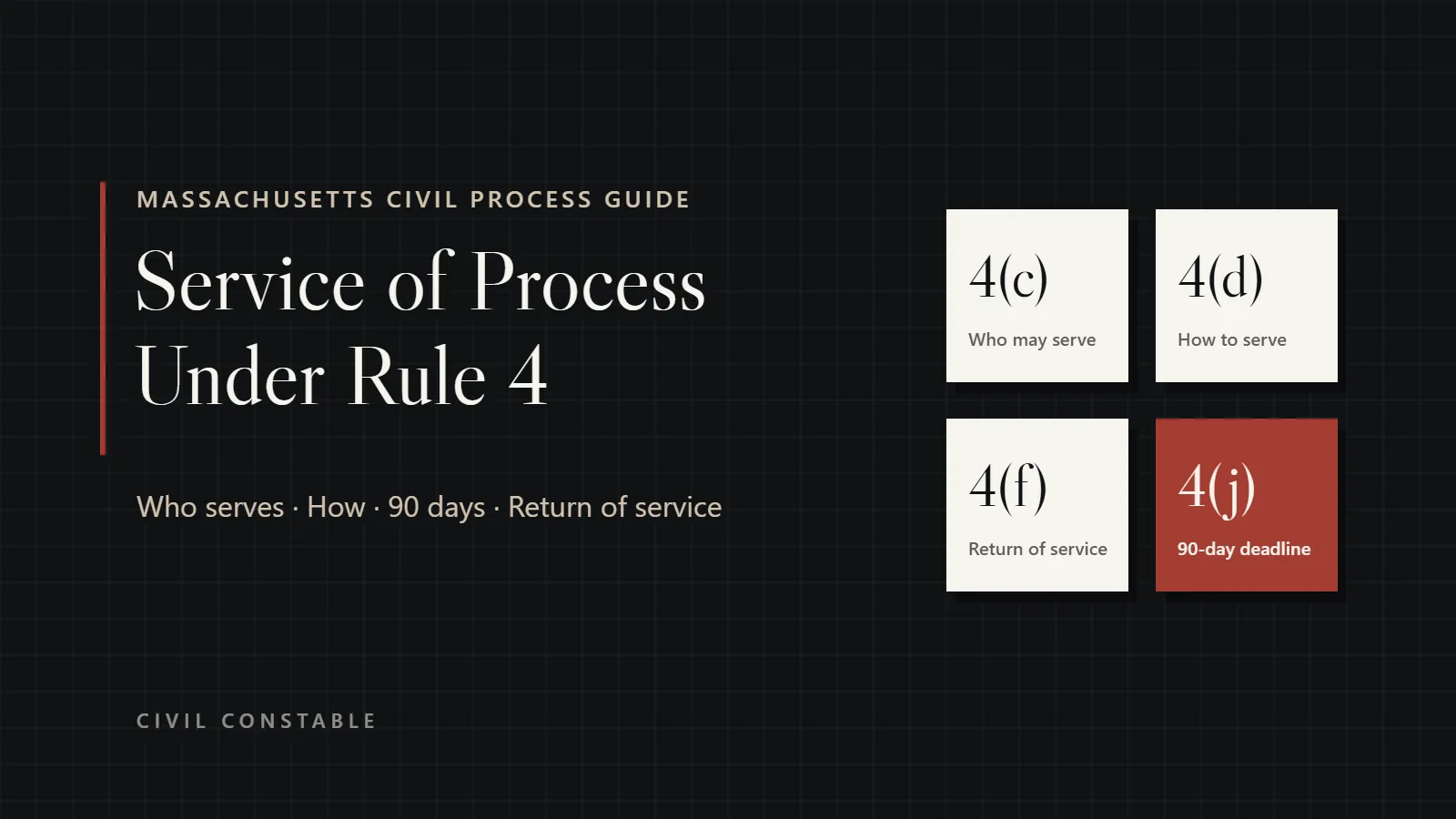
| Deadline to serve | Within 90 days after the complaint is filed, unless good cause is shown | Mass. R. Civ. P. 4(j) |
| Proof of service | A written return filed with the court; a server other than a sheriff files an affidavit | Mass. R. Civ. P. 4(f) |
| Time to answer | Generally 20 days after service, unless the court orders otherwise | Mass. R. Civ. P. 12(a) |
| Subpoenas | Any person who is not a party and is at least 18 | Mass. R. Civ. P. 45(c) |
Step 1: The summons and complaint
A civil action starts when the complaint is filed. The summons is signed by the clerk, and the plaintiff or the plaintiff's attorney fills it in. Under Rule 4(a), the plaintiff or attorney then delivers the complaint and a summons for service to a sheriff, deputy sheriff or special sheriff, or to another person authorized under Rule 4(c). The summons and complaint are served together.
Step 2: Choose someone with authority to serve
Rule 4(c) lists who may serve process:
- a sheriff, deputy sheriff or special sheriff
- any other person duly authorized by law
- a person specially appointed by the court for that purpose
Each of these gets authority from a different place:
- Sheriffs. County sheriff's offices have civil process divisions that serve papers in their county.
- Constables. Constables are appointed by a city or town. With the required bond, they may serve civil process within their town, up to dollar limits set by G.L. c. 41, § 92. Both conditions matter: the town and the amount at stake.
- Special process servers. A private process server generally needs a court order appointing them under Rule 4(c). Our Document Center has a motion to appoint a special process server and a proposed order.
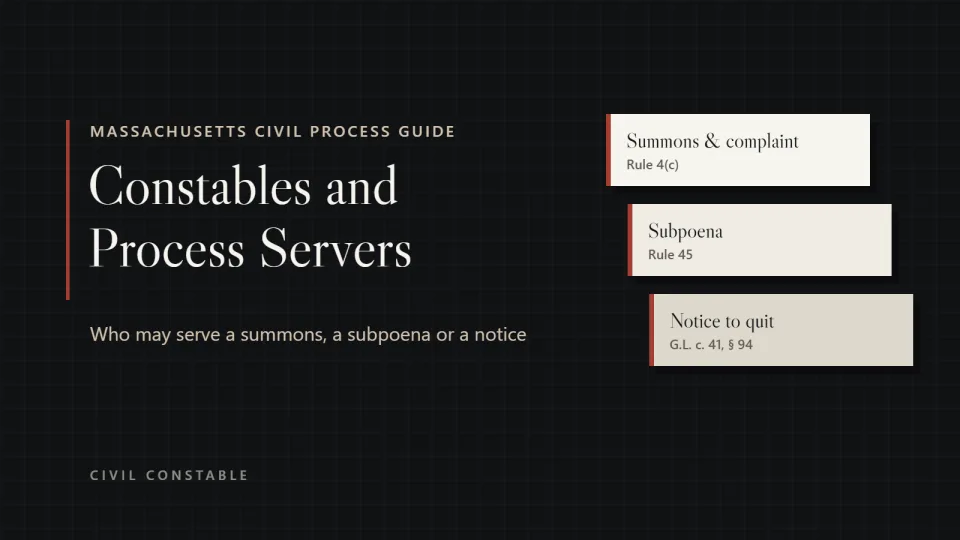
For a side-by-side comparison, see Constables and process servers in Massachusetts.
Step 3: Serve the defendant the right way
Individuals
Under Rule 4(d)(1), an individual may be served in any of three ways:
- by delivering the summons and complaint to the person
- by leaving copies at the person's last and usual place of abode
- by delivering them to an agent authorized by appointment or by statute to receive service
If the server cannot find the defendant after a diligent search, the plaintiff can ask the court for an order of notice.
Businesses and organizations
Under Rule 4(d)(2), a corporation or association is served by delivering the papers to one of these:
- an officer
- a managing or general agent
- the person in charge of business at its principal place of business in Massachusetts
- an agent authorized to receive service
The Commonwealth, cities and towns, and public bodies
Rules 4(d)(3) to (5) cover public defendants:
- The Commonwealth or a state agency (4(d)(3)): service on the Attorney General's office in Boston and, for an agency, on the agency itself.
- Cities and towns (4(d)(4)): service on the treasurer or the clerk.
- Authorities, boards and committees (4(d)(5)): service on the chairman or chief executive officer.
Certified or registered mail is allowed for these public defendants.
Defendants outside Massachusetts
When a statute allows out-of-state service, Rule 4(e) permits any of these methods:
- any Rule 4(d) method
- the method used by the courts of the place where service is made
- mail requiring a signed receipt
- a method directed in response to a letter rogatory
- a method the court orders
Have a summons and complaint to serve? Submit a summons and complaint request. We review the document, the address, the deadline and the authority before accepting the assignment.
Step 4: Meet the 90-day deadline
Rule 4(j) requires service within 90 days after the complaint is filed. If service isn't made in time and the plaintiff can't show good cause, the action is dismissed as to that defendant without prejudice. The court can do this on its own initiative after notice, or on a motion.
Build in time for more than one attempt, a changed address, and the possibility that you'll need a court-appointed server.
Step 5: File the return of service
Under Rule 4(f), the person who serves the papers must file proof of service with the court. It must be filed promptly, and in any event within the time the served person has to respond. A server other than a sheriff makes the proof by affidavit. For service by mail, the proof includes the signed receipt, or other evidence of delivery the court finds satisfactory. A missing return doesn't by itself make the service invalid, but the case can't move forward smoothly without it.
A good return states:
- who was served
- the date and time
- the address
- the manner of service (in hand, at last and usual abode, or on an agent)
Step 6: The response clock starts
Under Rule 12(a), the defendant generally must serve an answer within 20 days after service, unless the court orders otherwise. Rule 6 governs how to count: the day of service isn't counted, and a deadline that falls on a Saturday, Sunday or legal holiday moves to the next business day. Rule 6(d) adds three days when a party must act within a set time after being served by mail or electronic means. That mostly affects papers exchanged during the case, not the original summons.
What if service is defective?
Rule 12(b) lets a defendant raise "insufficiency of process" (12(b)(4)) and "insufficiency of service of process" (12(b)(5)). Under Rule 12(h)(1), these defenses are waived if the defendant leaves them out of a Rule 12 motion or a responsive pleading.
For plaintiffs, a challenge to service can mean delay, a motion, or service done again, sometimes close to the 90-day limit. The best defense is service by someone with clear authority, by a method the rule allows, with a precise return.
Other civil process: subpoenas, eviction papers and notices
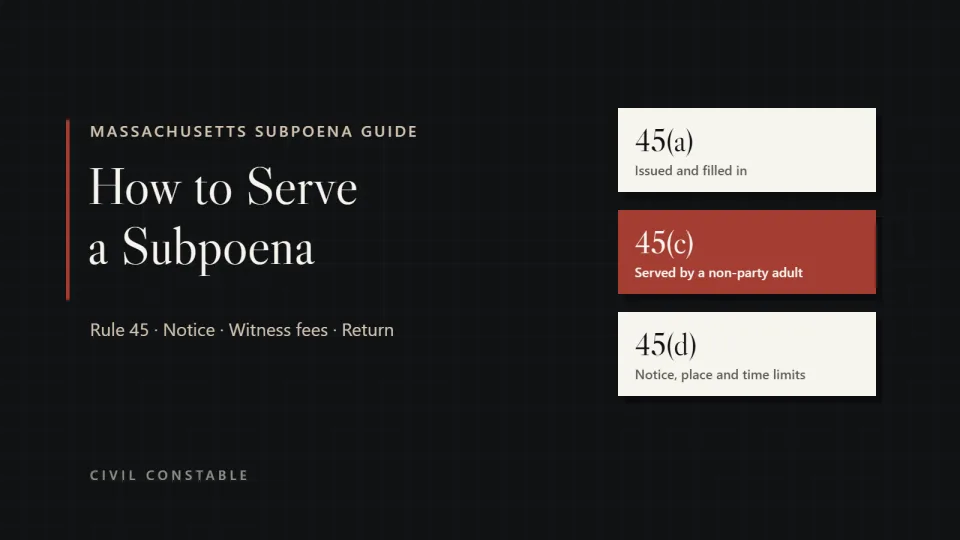
- Subpoenas. Under Mass. R. Civ. P. 45(c), any person who is not a party and is at least 18 may serve a subpoena. When attendance is required, one day's witness fee and mileage are tendered, except for subpoenas issued on behalf of the government. See subpoena service.
- Summary process (eviction). The summons and complaint must be served by someone authorized under Rule 4(c). Service must be no later than the seventh day and no earlier than the thirtieth day before the Monday entry day (Uniform Summary Process Rule 2). See The Massachusetts eviction process.
- Notices to quit and demands. These aren't court process. A constable's return of service of notices is prima facie evidence of delivery (G.L. c. 41, § 94). See Notice to quit in Massachusetts.
Frequently asked questions
Who can serve civil process in Massachusetts?
For a summons and complaint, Rule 4(c) lists three groups: sheriffs and their deputies, any other person duly authorized by law (such as a constable within their statutory authority), and a person specially appointed by the court. Subpoenas can be served by any non-party adult.
Can papers be left with someone at the defendant's home?
Rule 4(d)(1) allows service by leaving copies at the defendant's "last and usual place of abode." Whether a particular address qualifies is a factual question. If it is disputed, the defendant can challenge service under Rule 12(b)(5).
How long do I have to serve the complaint?
Rule 4(j) allows 90 days after the complaint is filed, unless you can show good cause for the delay.
How long does the defendant have to answer?
Generally 20 days after service under Rule 12(a), unless the court orders otherwise. Some case types and courts have their own rules, so check the summons.
What is "insufficient service of process"?
It is a defense under Rule 12(b)(5) that the papers weren't served the way the rules require. For example, the wrong person served them, or the wrong method was used. It must be raised early or it is waived (Rule 12(h)(1)).
Civil process service with Civil Constable
Civil Constable provides Massachusetts civil process and constable services. Before accepting any request, we review four things:
- the document
- the service address
- the deadline
- the source of authority
If the authority isn't there, we tell you before any work begins. Accepted assignments come with documented attempts and a return through the client portal.
Official sources
- Mass. R. Civ. P. 4: process
- Mass. R. Civ. P. 6: time
- Mass. R. Civ. P. 12: defenses and objections
- Mass. R. Civ. P. 45: subpoenas
- G.L. c. 41, § 92: constables; service of civil process
- Uniform Summary Process Rule 2
Court rules change. This article reflects the official text as reviewed in October 2026.