Este artículo solo está disponible en inglés. Todavía no se ha publicado una versión revisada en español. Si tiene preguntas al respecto, contáctenos.
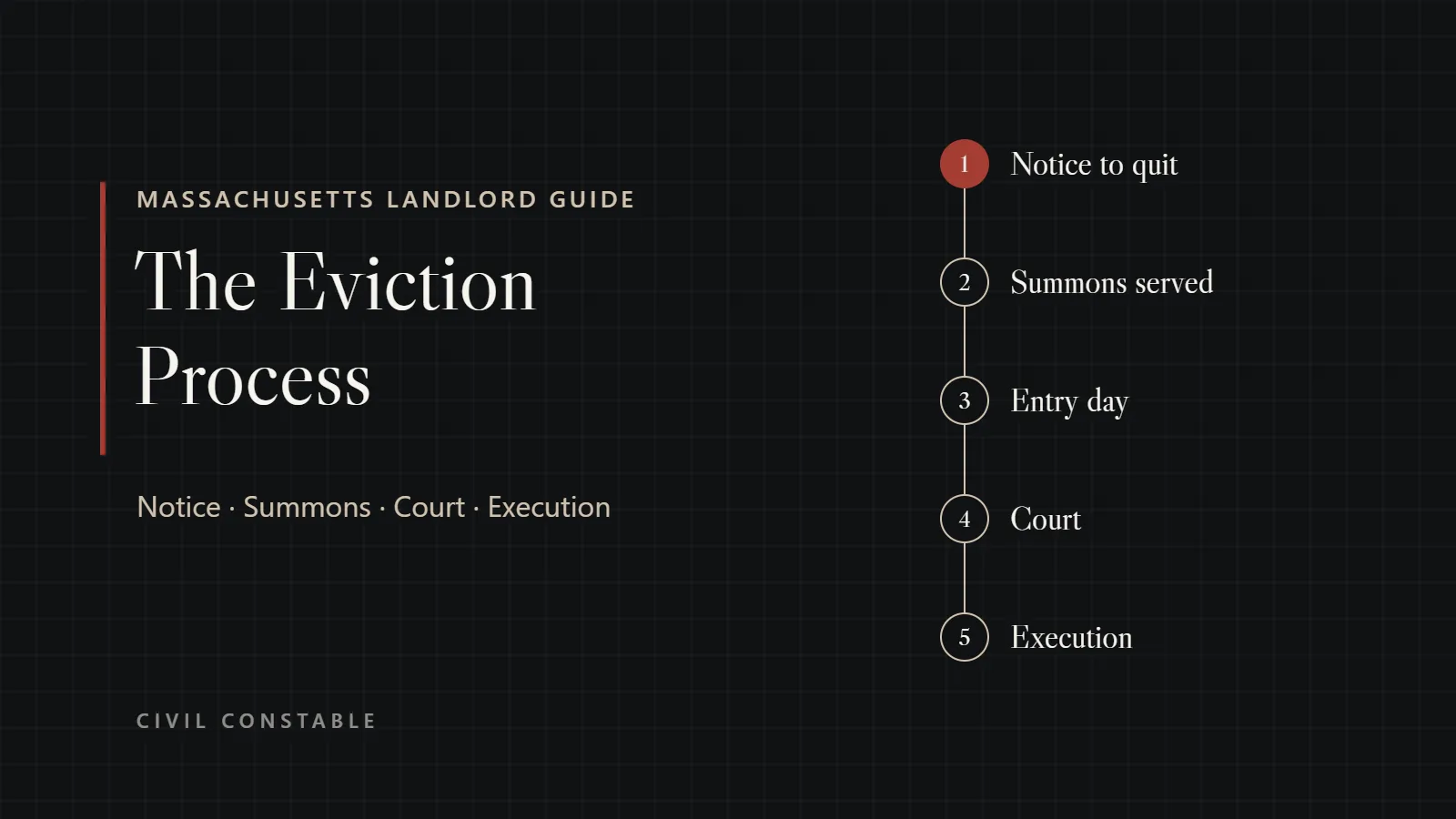
In Massachusetts, an eviction is a court case called summary process. The Massachusetts eviction process runs in a fixed order: end the tenancy with a notice to quit, have the Summary Process Summons and Complaint served, file it by the Monday entry day, go to court, and, if the landlord wins, recover possession through an execution served by an officer.
No step can be skipped. A landlord may not change the locks, remove belongings or shut off utilities to force a tenant out. Massachusetts law requires possession to be recovered through a chapter 239 action or other legal proceedings (G.L. c. 184, § 18), and self-help lockouts and utility shut-offs carry penalties and damages (G.L. c. 186, § 14).
General information, not legal advice. Civil Constable is not a law firm. For advice on a specific eviction, talk to a Massachusetts attorney or a court service center.
Step 1: End the tenancy with a notice to quit
The tenancy has to end before an eviction case can start. For nonpayment of rent, the statutes provide a 14-day notice (G.L. c. 186, §§ 11 and 12), and a residential nonpayment notice must be accompanied by the form required by G.L. c. 186, § 31. Ending a tenancy at will for other reasons usually takes notice equal to the rental period or 30 days, whichever is longer (§ 12).
Our guide, Notice to quit in Massachusetts, explains which notice applies and how to prove delivery. Need it delivered with a written return? Request notice to quit delivery.
Step 2: Wait for the notice period to end
Notice periods are generally counted from when the tenant receives the notice. In nonpayment cases, the tenant may have a right to pay the rent due and stop the termination (G.L. c. 186, §§ 11 and 12), so watch for payment before going further.
Step 3: Have the Summons and Complaint served
Once the tenancy has ended, the landlord or their attorney prepares a Summary Process Summons and Complaint and has it served by someone authorized under Mass. R. Civ. P. 4(c), such as a sheriff or a constable acting within their authority. Timing is strict. Under Uniform Summary Process Rule 2:
- Entry days are Mondays. The plaintiff chooses the entry day and writes it on the summons.
- Service must be made no later than the seventh day and no earlier than the thirtieth day before that entry day.
- Service cannot be made before the tenancy has ended.
A summons served outside that window can lead to dismissal, so leave a margin and use a server whose return records the exact date and manner of service. See who can serve process in Massachusetts and our summary process service.
Step 4: File with the court by the entry day
Under Rule 2(e), the Summons and Complaint, with the return of service, must be filed no later than the close of business on the Monday entry day. Filing by mail counts only when the clerk receives it. Cases are brought in the court for the area where the property is, such as the Housing Court or the District Court (G.L. c. 239, § 2). For nonpayment cases, § 31 says the court will not accept the filing without proof that the required form was delivered with the notice to quit.
Step 5: The tenant's answer and the trial date
Under Uniform Summary Process Rule 3, the tenant's answer is due no later than the first Monday after the entry day. It can raise defenses and, where the rules allow, counterclaims. Rule 2(c) places the case on the list for the second Thursday after the entry day, unless the court has designated another trial day. Standing orders can change parts of this schedule, so check the dates on the court's notices. Many cases are resolved through mediation; otherwise a judge decides, or a jury where one has been properly requested.
Step 6: Judgment and the 10-day appeal period
A party who wants to appeal must file a notice of appeal within 10 days after judgment enters, and an execution cannot issue until those 10 days have passed (G.L. c. 239, § 5). The execution is the court document that authorizes an officer to restore possession to the landlord.
Step 7: The execution and move-out
- Time limits. An execution for possession of a dwelling must issue within three months after judgment, excluding any time it was stayed. It cannot be served or levied more than three months after it issues (G.L. c. 235, § 23).
- Stays. When a tenancy ended without fault of the tenant (not for nonpayment), a judge may grant stays of up to six months in total. Where the household includes a handicapped person or someone 60 or older, stays can total up to twelve months (G.L. c. 239, § 9).
- 48-hour notice. At least 48 hours before levying, the officer must give the tenant written notice. It states the date and time of removal and the licensed public warehouse where any remaining belongings will be stored (G.L. c. 239, § 3).
- Days and hours. An execution for a dwelling may not be served or levied before 9 a.m., after 5 p.m., or on a Saturday, Sunday or legal holiday (G.L. c. 239, § 3).
- Belongings. Property removed must be stored with a licensed and bonded public warehouse, generally within 20 miles of the premises (G.L. c. 239, § 4).
How long does an eviction take in Massachusetts?
It depends on the notice period, the entry day you choose, the court's calendar, whether the tenant contests the case, any appeal, and any stay. At a minimum, add up:
- the notice period
- the 7-to-30-day window between service and the entry day
- the time to trial
- the 10-day appeal period
- the 48-hour notice before levy
Contested cases, continuances and stays can add weeks or months. Two of the deadlines landlords most often miss are within their control: the notice period and the service window.
Where a constable fits in
A constable can deliver a notice to quit with a written return as proof. Within their appointing town and statutory limits, a constable can also serve summary process papers (G.L. c. 41, § 92). Civil Constable reviews every request before accepting it: the document, the address, the deadline and the authority. You know where things stand before any work begins.
- Request summary process service
- Request notice to quit delivery
- Services for landlords and property managers
Official sources
- Uniform Summary Process Rule 2: summons, entry day, service and filing
- Uniform Summary Process Rule 3: the answer
- G.L. c. 186, § 12 and § 31: notices to quit
- G.L. c. 186, § 14 and G.L. c. 184, § 18: no self-help eviction
- G.L. c. 239, § 3, § 4, § 5 and § 9: execution, storage, appeal, stays
- G.L. c. 235, § 23: time limits for executions
Statutes, court rules and standing orders change. This article reflects the official text as reviewed in October 2026.