Este artículo solo está disponible en inglés. Todavía no se ha publicado una versión revisada en español. Si tiene preguntas al respecto, contáctenos.
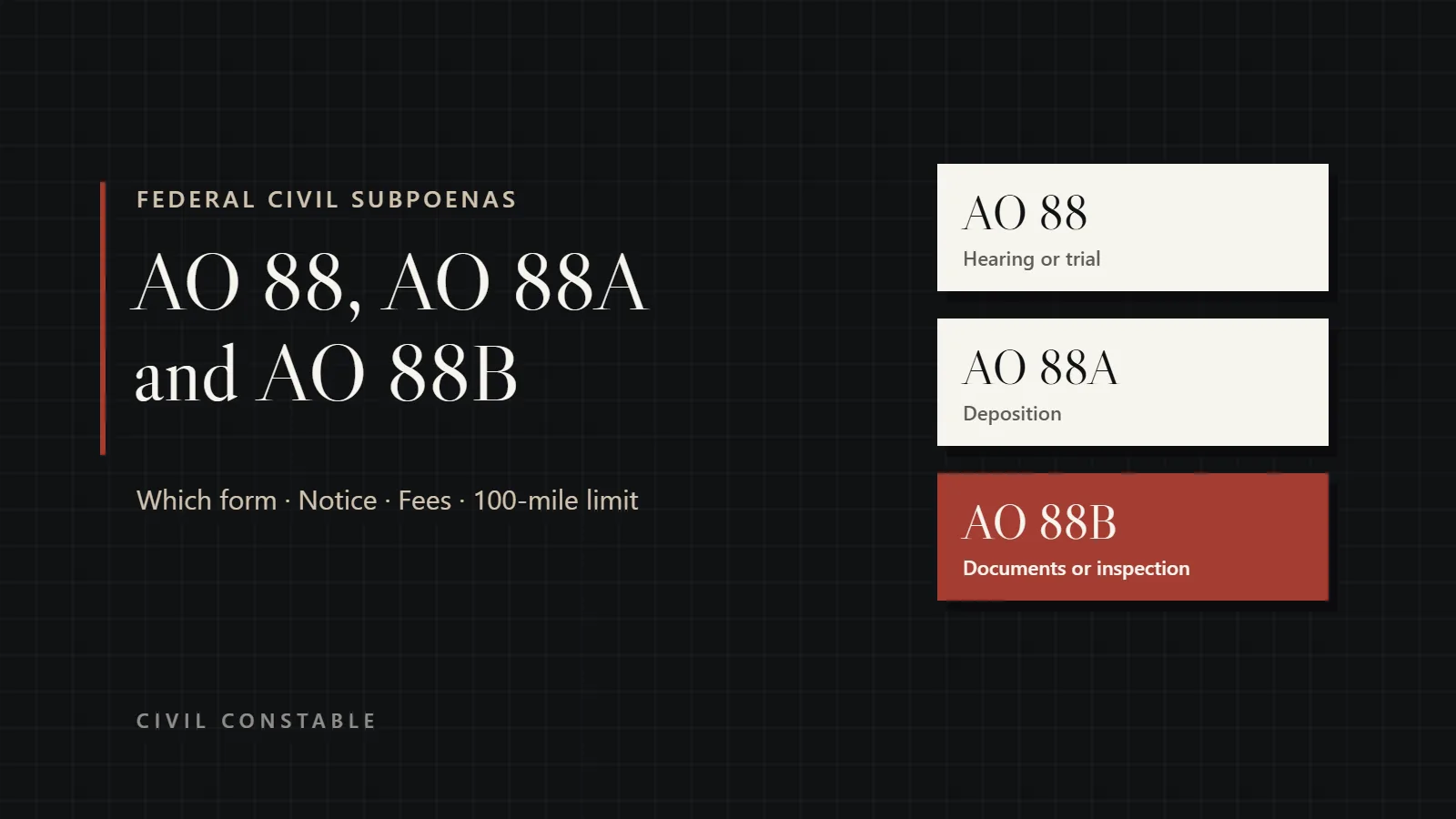
Federal civil cases use three standard subpoena forms published by the U.S. Courts:
- Form AO 88: to appear and testify at a hearing or trial
- Form AO 88A: to testify at a deposition
- Form AO 88B: to produce documents, information or objects, or to permit inspection of premises
All three are governed by Federal Rule of Civil Procedure 45, not by Massachusetts Rule 45. This guide explains which federal subpoena form to use, how it is issued and served, and the rules that most often trip people up. Those include notice to other parties, fees, the 100-mile limit and proof of service.
General information, not legal advice. Civil Constable is not a law firm. For a specific case, talk to an attorney.
Which federal subpoena form do you need?
| Form | Use it to | Our template page |
|---|---|---|
| AO 88 | Command a person to appear and testify at a hearing or trial in a civil action | AO 88 |
| AO 88A | Command a person to testify at a deposition, with optional production | AO 88A |
| AO 88B | Command production of documents, electronically stored information or tangible things, or inspection of premises, without a deposition | AO 88B |
Who issues a federal subpoena
Under Fed. R. Civ. P. 45(a)(2), a subpoena must issue from the court where the action is pending, even when compliance is required somewhere else. Under 45(a)(3), it can be issued in either of two ways:
- The clerk issues a signed but otherwise blank subpoena, and the requesting party completes it before service.
- An attorney authorized to practice in the issuing court issues and signs it.
Notice to other parties before a documents subpoena
If a subpoena commands production of documents, electronically stored information or tangible things, or inspection of premises, before trial, Rule 45(a)(4) requires notice first. A notice and a copy of the subpoena must be served on each party before it is served on the person it is directed to. This applies to AO 88B, and to AO 88A when it includes a production request.
Who may serve it, and fees
Under Rule 45(b)(1), any person who is at least 18 years old and not a party may serve a subpoena. Service requires delivering a copy to the named person. If the subpoena requires that person's attendance, the server must also tender the fees for one day's attendance and the mileage allowed by law. Fees aren't required when the subpoena issues on behalf of the United States or its officers or agencies. Under 45(b)(2), a subpoena may be served at any place within the United States.
Serving a federal subpoena in Massachusetts? Submit a subpoena service request with the issued form and any fee instructions. We review it before accepting the assignment.
The 100-mile limit on where compliance can be required
Rule 45(c) limits where a person can be made to comply:
- Trial, hearing or deposition: generally within 100 miles of where the person resides, is employed or regularly transacts business in person, with limited exceptions such as parties and party officers.
- Production of documents: at a place within 100 miles of where the person resides, is employed or regularly transacts business in person.
- Inspection of premises: at the premises to be inspected.
Objections and motions to quash
- Objections (45(d)(2)(B)). A person commanded to produce or permit inspection may serve a written objection. It must be served before the earlier of the time set for compliance or 14 days after the subpoena is served.
- Quashing (45(d)(3)). On a timely motion, the court where compliance is required must quash or modify a subpoena that:
- fails to allow a reasonable time to comply
- requires compliance beyond the geographic limits
- requires disclosure of privileged or other protected matter, if no exception or waiver applies
- subjects a person to undue burden
Proof of service
Under Rule 45(b)(4), proving service, when needed, requires filing a statement with the issuing court. The statement shows the date and manner of service and the names of the persons served, and must be certified by the server. Each AO form includes a proof-of-service page for this.
Federal vs. Massachusetts subpoenas
| Federal (Fed. R. Civ. P. 45) | Massachusetts (Mass. R. Civ. P. 45) | |
|---|---|---|
| Forms | AO 88, AO 88A, AO 88B | Massachusetts subpoena forms |
| Who serves | Any non-party at least 18 | Any non-party at least 18 |
| Place limit | Generally 100 miles | Generally 50 airline miles for residents, outside hearings and trials |
| Objection deadline (documents) | Earlier of compliance time or 14 days after service | 10 days after service, or by compliance if sooner |
For the state rules, see How to serve a subpoena in Massachusetts.
Frequently asked questions
What is Form AO 88B?
It's the federal form subpoena to produce documents, information or objects, or to permit inspection of premises, in a civil action. Use it when you need records or things from a non-party without taking their deposition.
What is the difference between AO 88A and AO 88B?
AO 88A commands testimony at a deposition, and may also request documents. AO 88B commands production or inspection only, with no testimony.
Can an attorney sign a federal subpoena?
Yes, if the attorney is authorized to practice in the issuing court (Rule 45(a)(3)).
Can a federal subpoena be served in Massachusetts for a case pending in another state?
A federal subpoena may be served anywhere in the United States (Rule 45(b)(2)). It must still issue from the court where the action is pending, and compliance must respect the 100-mile limits.
Request federal subpoena service
- Request subpoena service
- About our subpoena service
- Browse the Document Center
- For attorneys and law firms
Official sources
- Fed. R. Civ. P. 45: subpoena
- Federal Rules of Civil Procedure (U.S. Courts)
Court rules change. This article reflects the official text as reviewed in October 2026.