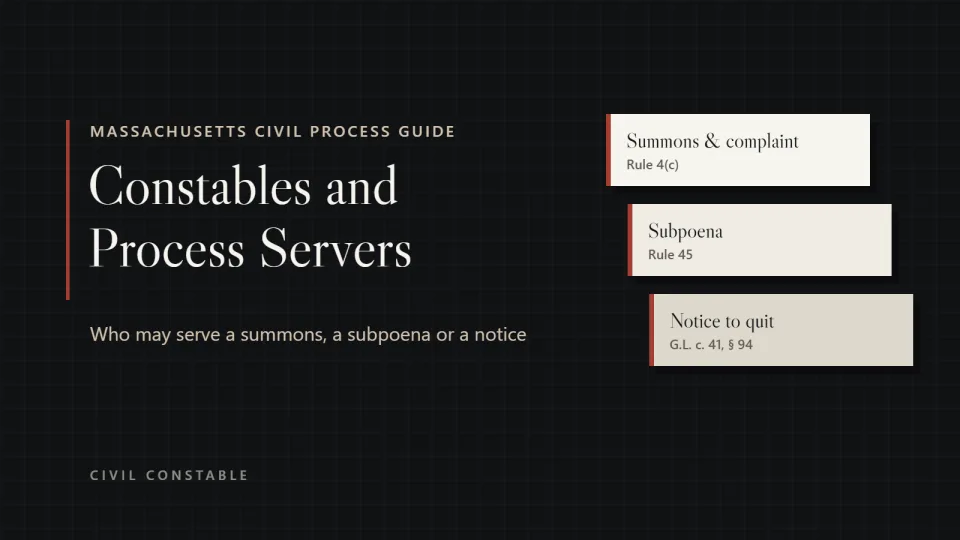
A subpoena orders a person to testify, to produce documents or other things, or both. In Massachusetts state courts, subpoenas are governed by Rule 45 of the Massachusetts Rules of Civil Procedure, and unlike a summons, they don't need a sheriff or constable to serve them. Correct subpoena service in Massachusetts still depends on getting the details right:
- the right type of subpoena
- notice to the other parties
- witness fees
- place and time limits
- a clear record of service
This guide walks through each step.
General information, not legal advice. Civil Constable is not a law firm. For a specific case, talk to an attorney or the court clerk.
The short answer
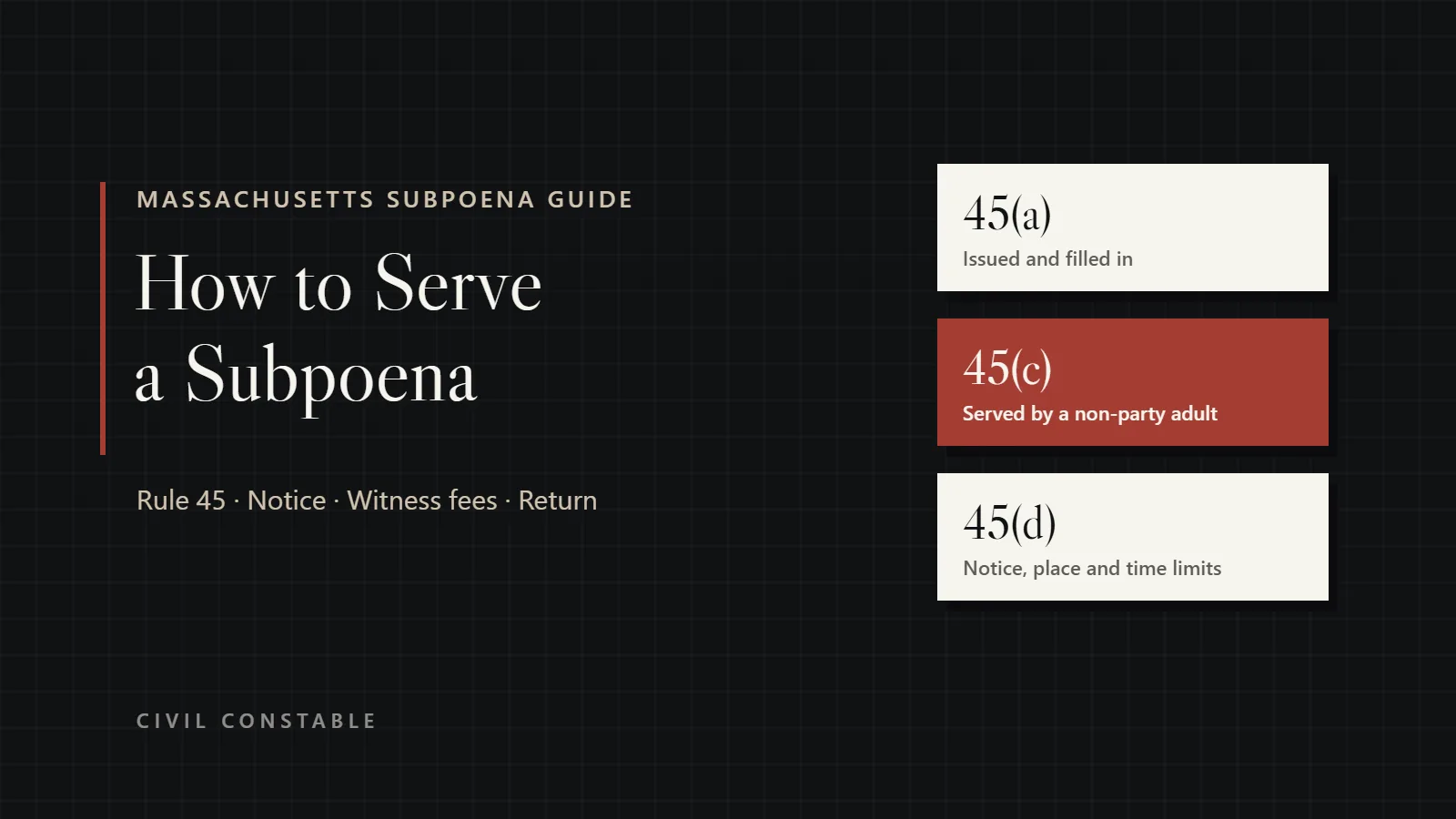
- Who may serve: any person who is not a party and is at least 18 years old (Mass. R. Civ. P. 45(c)).
- How: by delivering a copy to the person, by exhibiting and reading it to them, or by leaving a copy at their place of abode (45(c)).
- Fees: when attendance is required, the server also tenders one day's attendance fee and the mileage allowed by law, except for subpoenas issued on behalf of the government (45(c)). The statutory witness fee in G.L. c. 262, § 29 is six dollars a day and ten cents a mile.
- Documents-only subpoenas: a copy must be served on each party before the subpoena is served on the person who will produce (45(d)).
Step 1: Pick the right type of subpoena
Rule 45 covers several kinds of subpoena:
- Deposition subpoena. Commands a witness to testify at a deposition, with or without documents. A deposition subpoena can't issue until a notice of deposition has been served (45(d)).
- Documents-only (records-only) subpoena. Before trial, Rule 45(d) allows a subpoena that commands only production or inspection, without a deposition. The person producing doesn't have to appear in person (45(b)).
- Hearing or trial subpoena. Commands attendance, and production if needed, at a hearing or trial. It may be served at any place within the Commonwealth (45(e)).
Our Document Center has a Massachusetts deposition subpoena template with its Schedule A. It also has a records-only subpoena with its Schedule A and an optional custodian of records certification.
Step 2: Have it issued and filled in
Under Rule 45(a), a subpoena is issued by an official authorized by that rule, such as the clerk of the court. It is signed but otherwise blank, and the party fills it in before service. The subpoena must state the court and the title of the action. It may command:
- testimony
- production of documents, electronically stored information or tangible things
- inspection of premises
Check the issued subpoena carefully before service. A wrong date, an unclear records request or a missing schedule is easier to fix before it reaches the witness.
Step 3: Give the other parties notice (documents-only subpoenas)
For a documents-only subpoena, Rule 45(d) requires a copy to be served on each party before the subpoena is served on the person who will produce. The serving party must also pass along to each party any objection received, plus notice of the production or a copy of it.
Step 4: Serve the subpoena and tender fees
Any non-party adult may serve a Massachusetts subpoena (45(c)). Service is made by delivering a copy to the person named, by exhibiting and reading it to them, or by leaving a copy at their place of abode.
When the subpoena commands attendance, the fees for one day's attendance and the mileage allowed by law are tendered along with it. G.L. c. 262, § 29 sets the general witness fee at six dollars a day and ten cents a mile for travel out and home. The fee requirement doesn't apply to subpoenas issued on behalf of the United States, the Commonwealth, or their political subdivisions or agencies.
Even though anyone qualified may serve, many attorneys use a professional for three reasons:
- the return records exactly when, where and how service was made
- it states whether fees were tendered
- the attorney doesn't have to rely on a staff member's memory if service is challenged
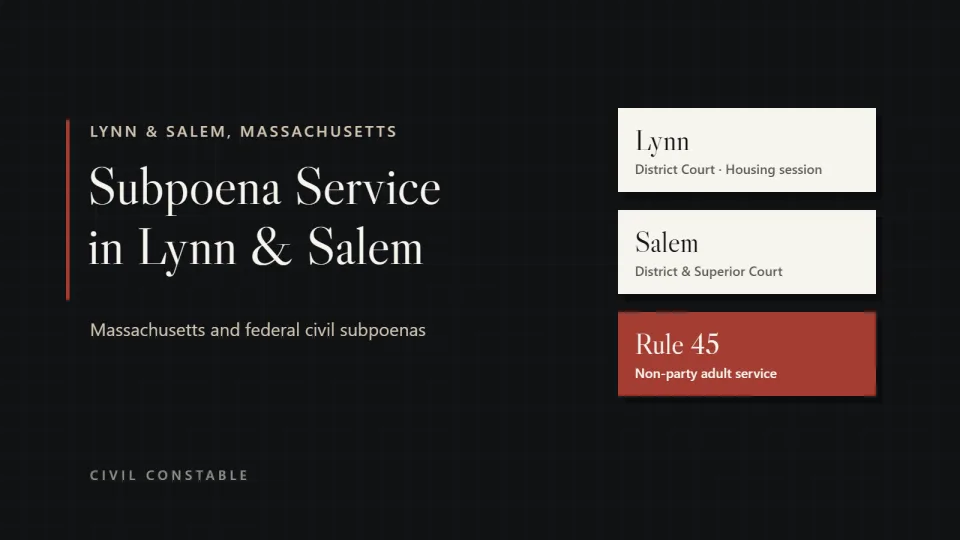
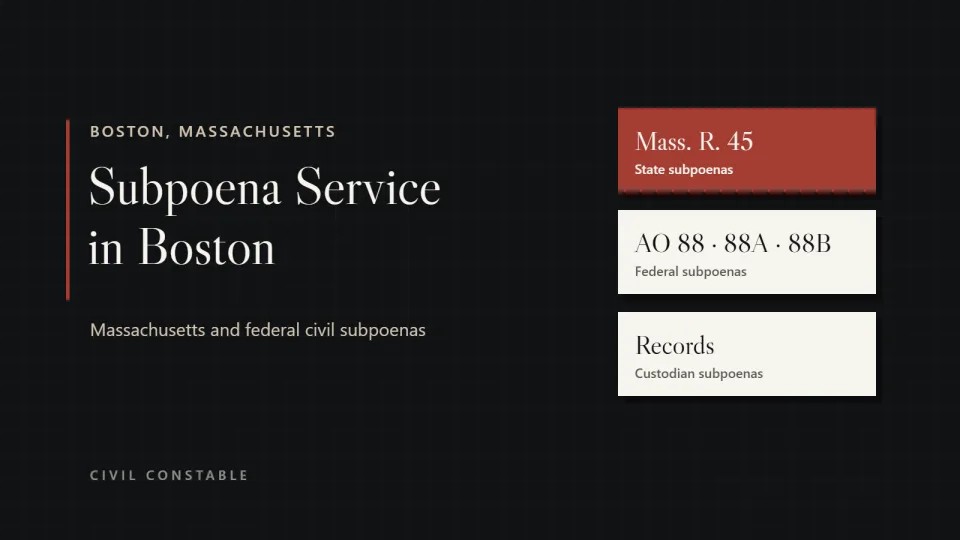
Need a subpoena served? Submit a subpoena service request. Upload the issued subpoena, the event or production date, the witness or records custodian, and your fee-tender instructions. Subpoena service doesn't depend on a constable's town, so we review requests for addresses across Massachusetts. See our pages on subpoena service in Boston and subpoena service in Lynn and Salem.
Step 5: Respect place and time limits
- Massachusetts residents: unless the court orders otherwise, and except for hearings and trials, a resident can't be required to attend or produce more than 50 airline miles from the nearest of their residence, employment or place of business (45(d)).
- Nonresidents served in Massachusetts: they may be required to attend or produce only in the county where served, within 50 airline miles of the place of service, or at a place the court sets (45(d)).
- Subpoenas to parties: at least 30 days must be allowed for compliance. A defendant can't be required to comply within 45 days after service of the summons and complaint, unless the court sets a different time (45(d)).
Step 6: Objections, motions and contempt
- Written objection. A person commanded to produce or permit inspection may serve a written objection within 10 days after service, or by the compliance date if that is sooner. After an objection, the serving party can't inspect or copy the materials without a court order, and may move to compel (45(d)).
- Motion to quash. A motion to quash or modify must be made promptly, and no later than the compliance time. The court may quash or modify a subpoena that is "unreasonable and oppressive" (45(b)).
- Contempt. Failure to obey a properly served subpoena without adequate excuse may be treated as contempt of the court where the action is pending (45(g)).
Federal subpoenas are different
Federal cases use Federal Rule of Civil Procedure 45 and the federal forms AO 88, AO 88A and AO 88B, not the Massachusetts forms. The federal rule has its own requirements:
- a 100-mile limit on the place of compliance
- a 14-day deadline for written objections
- proof of service filed as a certified statement
See our guide to federal subpoena forms AO 88, AO 88A and AO 88B.
Frequently asked questions
Can I serve a subpoena myself in Massachusetts?
Not if you're a party. Rule 45(c) requires the server to be a non-party at least 18 years old.
Does a constable have to serve a subpoena?
No. Any qualified non-party adult may serve one. Many attorneys still use a constable or professional server for a dependable return and fee handling.
How much is the witness fee in Massachusetts?
G.L. c. 262, § 29 sets six dollars a day and ten cents a mile for travel out and home in the general case. Check whether a different provision applies to your proceeding.
Do I need to notify the other side before serving a records subpoena?
Yes. For a documents-only subpoena, Rule 45(d) requires serving a copy on each party before serving the person who will produce.
Request subpoena service
Civil Constable serves Massachusetts and federal civil subpoenas. Before accepting a request, we review:
- the subpoena type
- the timing
- the address
- the fee-tender instructions
Accepted assignments come with documented attempts and a return through the client portal.
- Request subpoena service
- About our subpoena service
- For attorneys and law firms
- Massachusetts civil process: service under Rule 4
Official sources
- Mass. R. Civ. P. 45: subpoenas
- G.L. c. 262, § 29: witness fees
- Fed. R. Civ. P. 45: federal subpoenas
Court rules change. This article reflects the official text as reviewed in October 2026.