A Massachusetts notice to quit is the written notice a landlord gives to end a residential tenancy. Before a landlord can file an eviction case, which Massachusetts calls summary process, the tenancy has to be ended, and for most tenancies a notice to quit is how that happens. Three things decide whether the notice holds up:
- the right notice period for the reason the tenancy is ending
- the required paperwork, especially for nonpayment
- proof of when the tenant actually received the notice
This guide covers each of these, with links to the statutes.
The short answer
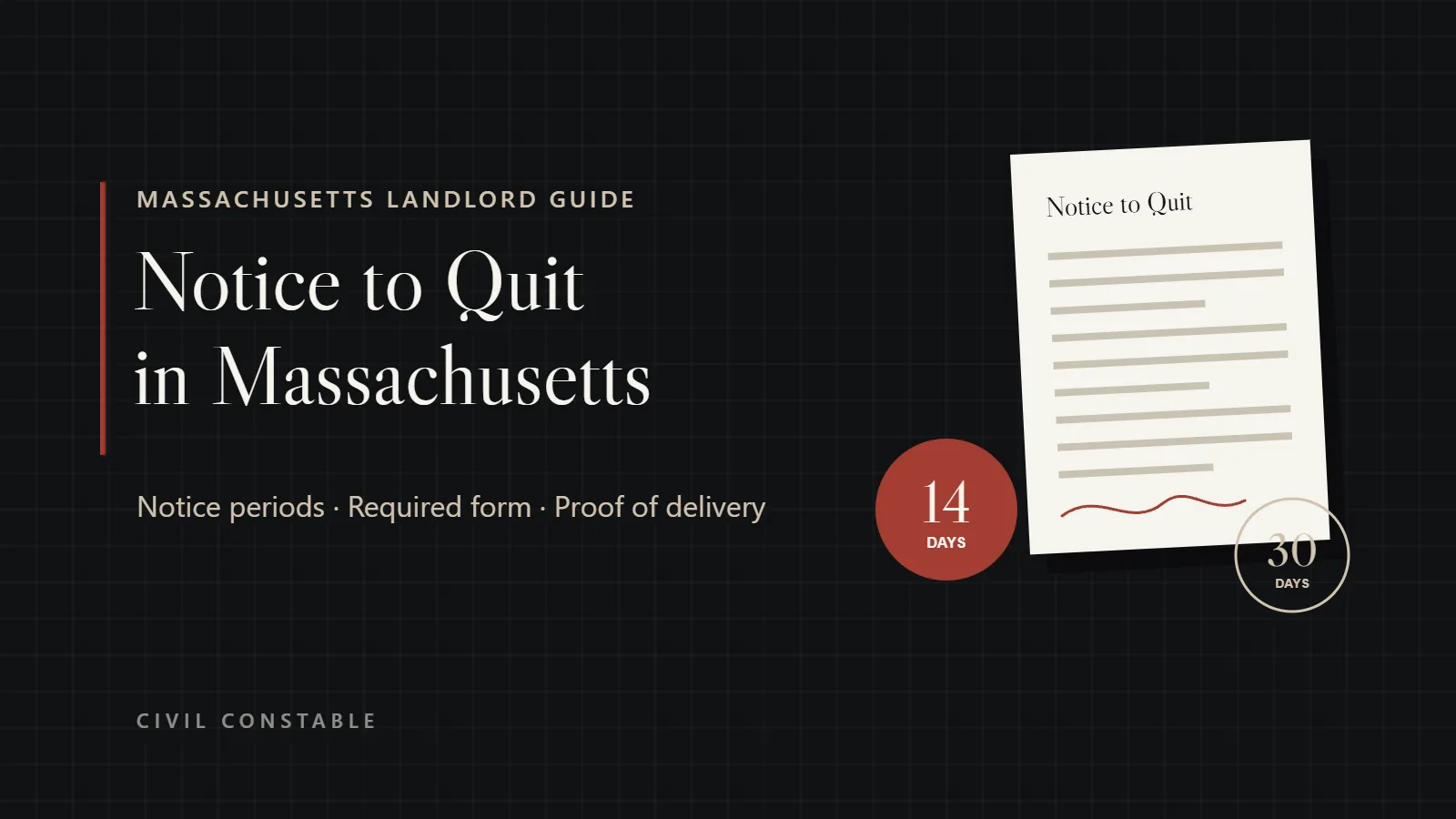
- Nonpayment of rent: 14 days' written notice, whether there is a written lease or a tenancy at will (G.L. c. 186, §§ 11 and 12).
- Ending a tenancy at will for no fault: written notice of at least the interval between rent days or 30 days, whichever is longer (G.L. c. 186, § 12).
- Nonpayment notices to residential tenants must be accompanied by the state's required form (G.L. c. 186, § 31).
- Anyone can deliver it: a notice to quit is not court process, and the statutes reviewed here don't require a particular person to deliver it. Many landlords use a constable because a constable's return of service is prima facie evidence of delivery (G.L. c. 41, § 94).
This article is general information, not legal advice. Civil Constable is not a law firm and doesn't choose which notice to use or calculate termination dates. For a specific tenancy, talk to an attorney.
Which notice to quit applies?
The notice period depends on two things: why the tenancy is ending, and what kind of tenancy it is.
| Situation | Notice in the statute | Source |
|---|---|---|
| Rent unpaid, written lease | 14 days' notice in writing | G.L. c. 186, § 11 |
| Rent unpaid, tenancy at will | 14 days' notice in writing | G.L. c. 186, § 12 |
| Ending a tenancy at will, no fault | Three months' notice in writing. If rent is paid more often than every three months, the interval between rent days or 30 days, whichever is longer | G.L. c. 186, § 12 |
Most residential tenancies at will pay rent monthly. That is why the no-fault notice is commonly called a "30-day notice." For a monthly tenancy, the period is the longer of the rent interval or 30 days.
When a tenancy at will is ended without fault of the tenant, G.L. c. 186, § 13 says no action for possession may be brought until that period has passed. The period is counted from when the tenant receives the written notice.
Tenancies for a fixed term, and terminations for reasons other than rent, may also depend on what the lease says. Those situations are a good reason to involve an attorney before any notice goes out.
The 14-day notice and the tenant's right to cure
A 14-day notice for nonpayment doesn't always end the tenancy. The statutes give tenants a chance to pay:
- Tenancy at will: if the tenant hasn't received a similar notice in the previous twelve months, they can stop the termination. They do this by paying or tendering the full rent due within ten days after receiving the notice (G.L. c. 186, § 12).
- Required notification: § 12 requires every nonpayment notice to a tenant at will to contain a specific notification of that right. If it is missing, the tenant's time to pay is extended to the day the answer is due in the eviction case.
- Written lease: the tenant can pay all rent then due, with interest and costs, on or before the day the answer is due in the landlord's case (G.L. c. 186, § 11).
Our free 14-day notice to quit template includes the cure-rights notification. The 30-day notice to quit template covers no-fault termination of a tenancy at will. Both can be filled in online or downloaded as PDFs.
The form that must go with a nonpayment notice
A residential notice to quit for nonpayment of rent must be accompanied by a form prepared by the Executive Office of Housing and Livable Communities (EOHLC) (G.L. c. 186, § 31). The form includes:
- information on rental assistance
- the applicable court rules
- a prominent statement that the notice to quit is not an eviction, and that only a court order can force a tenant to leave
This step has teeth. Under § 31, a court will not accept a summary process summons and complaint for nonpayment of residential rent without proof that the form was delivered. EOHLC publishes the form on mass.gov, with instructions in several languages.
How to serve a notice to quit in Massachusetts
Who may deliver it
A notice to quit is not a summons. The statutes reviewed for this guide don't name a particular person who must deliver it, so landlords and property managers sometimes hand-deliver notices themselves.
The question that matters later is proof. The notice periods run from the tenant's receipt, and a nonpayment case can't be filed without proof the EOHLC form was delivered. A landlord needs to be able to show what was delivered, to whom, and when.
Why landlords use a constable
G.L. c. 41, § 94 allows constables to serve demands, notices and citations by attested copy. It makes their returns of service prima facie evidence of that service, while adding that this "shall not exclude the service thereof by other persons."
A constable's return is a signed record of the delivery. It lists the document, including any accompanying form, the date and time, the address, and how it was delivered. That record exists from the day of delivery, instead of being reconstructed from memory months later.
Need a notice to quit delivered with a written return? Submit a notice to quit request. Upload the signed notice and, for nonpayment, the EOHLC form. We review the request before accepting it.
A delivery checklist
- The notice is signed and names every tenant on the tenancy.
- For nonpayment, the EOHLC form is attached. Keep a copy of exactly what was delivered.
- Record the date, time, full address (including unit) and method of delivery.
- Keep the signed return or a signed statement from whoever delivered it.
- Note the date of receipt, because the notice periods run from it.
After the notice period ends
A notice to quit does not let a landlord change the locks, remove belongings or force anyone out. Only a court can order a tenant to leave.
If the tenant is still in possession after the tenancy has ended, the next step is a summary process case under G.L. c. 239. The summary process summons and complaint is court process. Under Uniform Summary Process Rule 2:
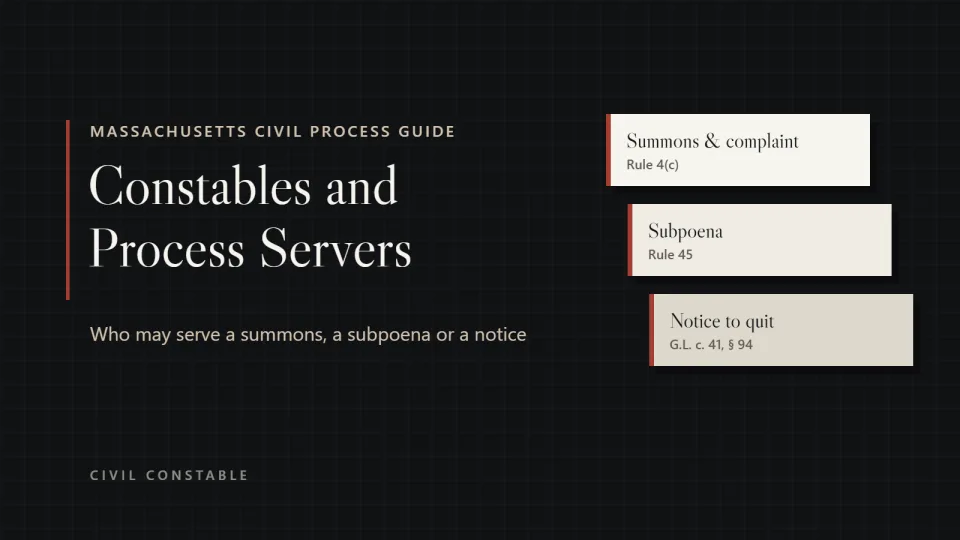
- it must be served by someone authorized under Mass. R. Civ. P. 4(c)
- it must be served no later than the seventh day and no earlier than the thirtieth day before the entry day
- it cannot be served before the tenancy has ended
Constables with the required bond may serve chapter 239 process within their own town (G.L. c. 41, § 92).
For a closer look at who may serve which documents, see Constables and process servers in Massachusetts. For the court stage, see our summary process service page.
Frequently asked questions
Is a notice to quit the same as an eviction?
No. A notice to quit ends the tenancy. An eviction happens only through a court case and a court order. The EOHLC form that accompanies nonpayment notices says this in capital letters.
Does a constable have to serve a notice to quit in Massachusetts?
The statutes reviewed for this guide don't require it. Landlords often choose a constable because a constable's return is prima facie evidence of the delivery (G.L. c. 41, § 94).
Does the EOHLC form go with a 30-day notice?
Section 31 applies to a residential notice to quit for nonpayment of rent. A no-fault notice ending a tenancy at will isn't a nonpayment notice. If you're unsure which kind your notice is, ask an attorney before delivering it.
When does the notice period start?
The statutes count from the tenant's receipt of the notice. That is why the date and method of delivery should be recorded.
Can Civil Constable tell me which notice to use?
No. We don't choose notices, calculate dates or give legal advice. We review the notice you provide for completeness before accepting a delivery assignment, and we document the delivery.
Request notice to quit delivery
Civil Constable provides documented delivery of notices to quit and other landlord notices in Massachusetts. Before accepting a request, we check that:
- the notice is signed and complete
- the premises and occupants are identified
- nonpayment notices include the EOHLC form
- the requested delivery date is workable
- Request notice to quit delivery
- How our notice to quit service works
- Services for landlords and property managers
- Ask about coverage and a quote
Official sources
- G.L. c. 186, § 11: nonpayment notice, written lease
- G.L. c. 186, § 12: ending a tenancy at will; nonpayment and the right to cure
- G.L. c. 186, § 13: possession after ending a tenancy at will
- G.L. c. 186, § 31: form required with a nonpayment notice
- EOHLC notice to quit accompanying form
- G.L. c. 41, § 94: constables; service of notices
- Uniform Summary Process Rule 2: serving the summons and complaint
Statutes and court rules change. This article reflects the official text as reviewed in October 2026.